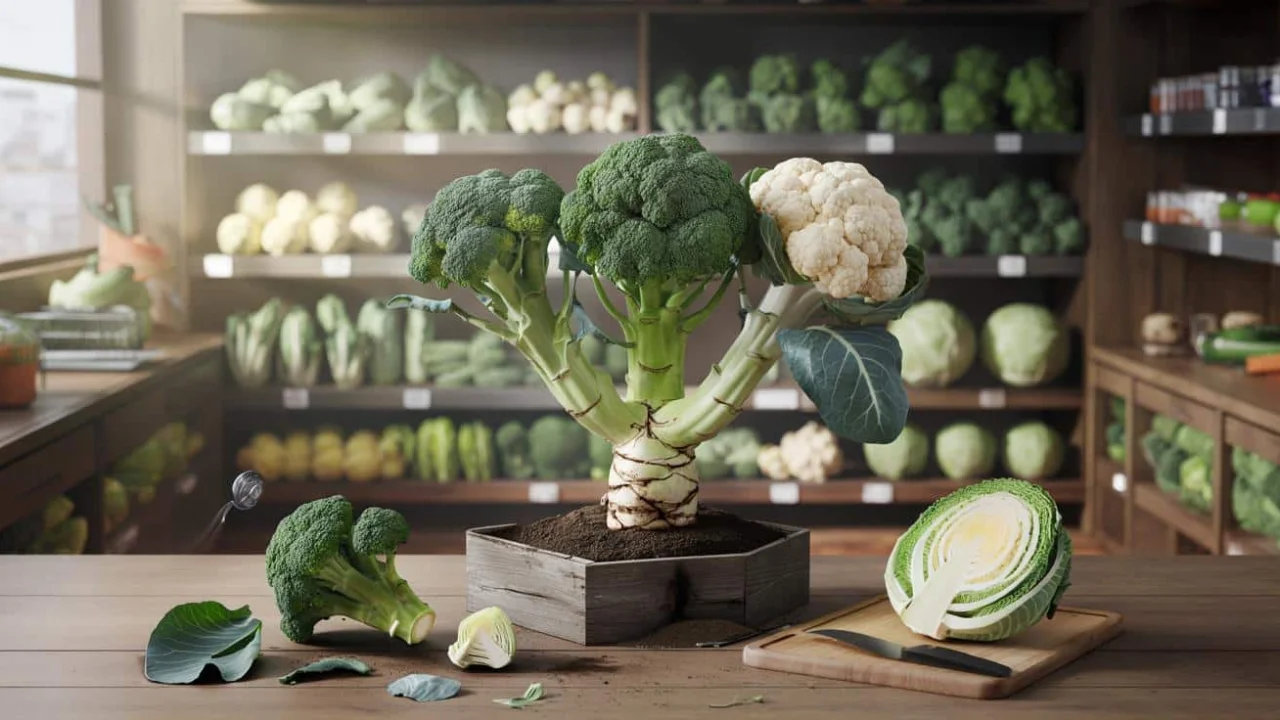
Last Tuesday at my local grocery store, I watched a woman juggle three different vegetables while her toddler tugged at her shopping cart. “This broccoli will make you big and strong,” she explained, holding up the green florets. Then she grabbed some cauliflower: “And this one’s perfect for our low-carb dinner.” Finally, a head of cabbage went into the cart for weekend soup prep.
Three vegetables, three distinct purposes, three different price tags. I smiled at the familiar scene until a conversation with my neighbor, a retired botanist, came flooding back: “You realize they’re all the same plant, right?” she’d mentioned casually while we were both watering our gardens.
That comment sent me down a research rabbit hole that completely changed how I see the produce aisle. What I discovered makes our entire approach to nutrition advice look like an elaborate shell game.
The Great Brassica Deception: One Plant, Multiple Identities
Here’s the truth that would make any grocery store manager uncomfortable: broccoli, cauliflower, cabbage, kale, Brussels sprouts, and kohlrabi are all Brassica oleracea cultivars. They’re not different species. They’re not even different subspecies. They’re the same wild coastal plant that humans have been selectively breeding for over 2,000 years.
“We basically took one plant and played dress-up with it for centuries,” explains Dr. Sarah Martinez, a plant geneticist at UC Davis. “Each ‘vegetable’ is just us emphasizing different parts of the same genetic blueprint.”
Think of it like dog breeds. A Chihuahua and a Great Dane look completely different, but they share 99.9% of their DNA. That’s exactly what happened with our beloved cruciferous vegetables. Ancient farmers noticed that some wild cabbage plants had bigger leaves, others had denser flower clusters, and still others had tighter buds. They kept selecting for these traits until we ended up with what looks like completely different vegetables.
The wild ancestor still grows along Mediterranean coastlines today, looking like a scraggly, loose-leafed plant that most people would dismiss as a weed. Yet this humble plant became the foundation of a multi-billion dollar vegetable industry.
Breaking Down the Brassica Family Tree
Understanding how these Brassica oleracea cultivars developed reveals just how arbitrary our vegetable categories really are:
| Cultivar | Plant Part Enhanced | Development Period | Main Characteristic |
|---|---|---|---|
| Cabbage | Leaves | 600 BCE | Tight, overlapping leaf head |
| Kale | Leaves | 600 BCE | Loose, curly leaves |
| Brussels Sprouts | Lateral buds | 1200s CE | Mini-cabbages along stem |
| Broccoli | Flower buds | 1500s CE | Dense cluster of unopened flowers |
| Cauliflower | Flower head | 1500s CE | Compact, undeveloped inflorescence |
| Kohlrabi | Stem | 1400s CE | Swollen stem base |
The timeline alone is revealing. Humans created what we now consider completely different vegetables across nearly 2,000 years of selective breeding. Each generation of farmers simply kept the plants that looked most like what they wanted.
“The genetic differences between these cultivars are incredibly small,” notes Dr. James Wong, a botanical researcher. “We’re talking about maybe a dozen genes out of roughly 45,000 total genes in the plant’s genome.”
The Nutrition Science Problem Nobody Talks About
Here’s where things get uncomfortable for the wellness industry. If all these vegetables are essentially the same plant, why do nutrition guides treat them like completely different superfoods?
The answer reveals a fundamental flaw in how we approach nutritional research. Scientists typically study foods in isolation, comparing broccoli to other vegetables or analyzing cauliflower’s vitamin content against established nutritional databases. But they rarely acknowledge that they’re often comparing different parts of the same plant.
- Broccoli gets praised for vitamin K because we eat the flower buds, which concentrate certain nutrients
- Cabbage gets credit for vitamin C because the leaves store different compounds
- Kale becomes a “superfood” because we eat younger leaves with higher nutrient density
- Brussels sprouts get labeled as fiber powerhouses because we’re eating compressed leaf clusters
But here’s the kicker: the base nutritional profile is remarkably similar across all these Brassica oleracea cultivars. The differences we obsess over often amount to variations you’d see between a tomato picked in June versus one picked in August.
“We’ve created this elaborate mythology around vegetables that are basically identical twins,” observes Dr. Lisa Chen, a nutritional biochemist. “It’s like rating different cuts of the same piece of meat and pretending they’re completely different foods.”
What This Means for Your Shopping Cart
This revelation doesn’t mean you should throw out your meal planning, but it should change how you think about vegetable variety. If you’re paying premium prices for “superfood” kale when regular cabbage offers nearly identical nutrition, you might want to reconsider your grocery budget.
The real nutritional differences between these Brassica oleracea cultivars come down to:
- Which part of the plant you’re eating (leaves vs. flowers vs. stems)
- How fresh the vegetable is when you buy it
- How you prepare and cook it
- The growing conditions and soil quality
These factors matter far more than whether you choose broccoli over cauliflower for your Tuesday dinner. A fresh head of cabbage from your local farmer’s market will likely outperform week-old “superfood” kale from across the country.
The implications extend beyond personal shopping decisions. The entire supplement industry has built products around extracting specific compounds from different Brassica vegetables, often charging premium prices for what amounts to variations of the same plant chemistry.
“When you see supplements claiming unique benefits from Brussels sprouts extract versus broccoli extract, remember that you’re essentially comparing different preparations of the same raw material,” warns Dr. Martinez.
This doesn’t diminish the genuine health benefits of eating these vegetables. Brassica oleracea cultivars really are nutritional powerhouses, packed with vitamins, minerals, and beneficial plant compounds. The issue isn’t with the vegetables themselves—it’s with the marketing narratives that treat them like completely different foods.
Rethinking the Rainbow on Your Plate
Understanding that these vegetables are all the same species should actually be liberating. Instead of stressing about getting the “right” superfood, focus on eating more plants in general. If Brussels sprouts are expensive this week, grab some cabbage. Can’t find fresh broccoli? Cauliflower will give you nearly identical nutrition.
The “eat the rainbow” advice still holds true, but maybe we should expand our definition of what counts as variety. Instead of obsessing over different Brassica cultivars, try mixing in vegetables from completely different plant families: sweet potatoes, bell peppers, carrots, or spinach.
This botanical reality check also highlights how much our food perceptions are shaped by marketing rather than science. The same plant that gets dismissed as “boring cabbage” suddenly becomes exciting when it’s rebranded as trendy Brussels sprouts or superfood kale.
FAQs
Are broccoli, cauliflower, and cabbage really the same plant?
Yes, they’re all cultivars of Brassica oleracea, selectively bred from the same wild ancestor over thousands of years.
Do these vegetables have different nutritional values?
The differences are smaller than most people think, mainly reflecting which part of the plant you’re eating rather than fundamentally different nutrition profiles.
Should I stop buying expensive “superfood” vegetables?
Focus on freshness and variety across plant families rather than paying premium prices for different versions of the same species.
Why don’t nutrition labels mention this relationship?
Current food labeling focuses on how we use foods rather than their botanical relationships, which can be misleading for consumers.
Are there other vegetables that are secretly the same plant?
Yes, many vegetables share common ancestors, but the Brassica oleracea family is one of the most dramatic examples of one species becoming multiple “different” foods.
Does cooking method matter more than which Brassica vegetable I choose?
Absolutely. How you prepare these vegetables affects their nutritional value far more than whether you pick broccoli over cauliflower.

Related Posts