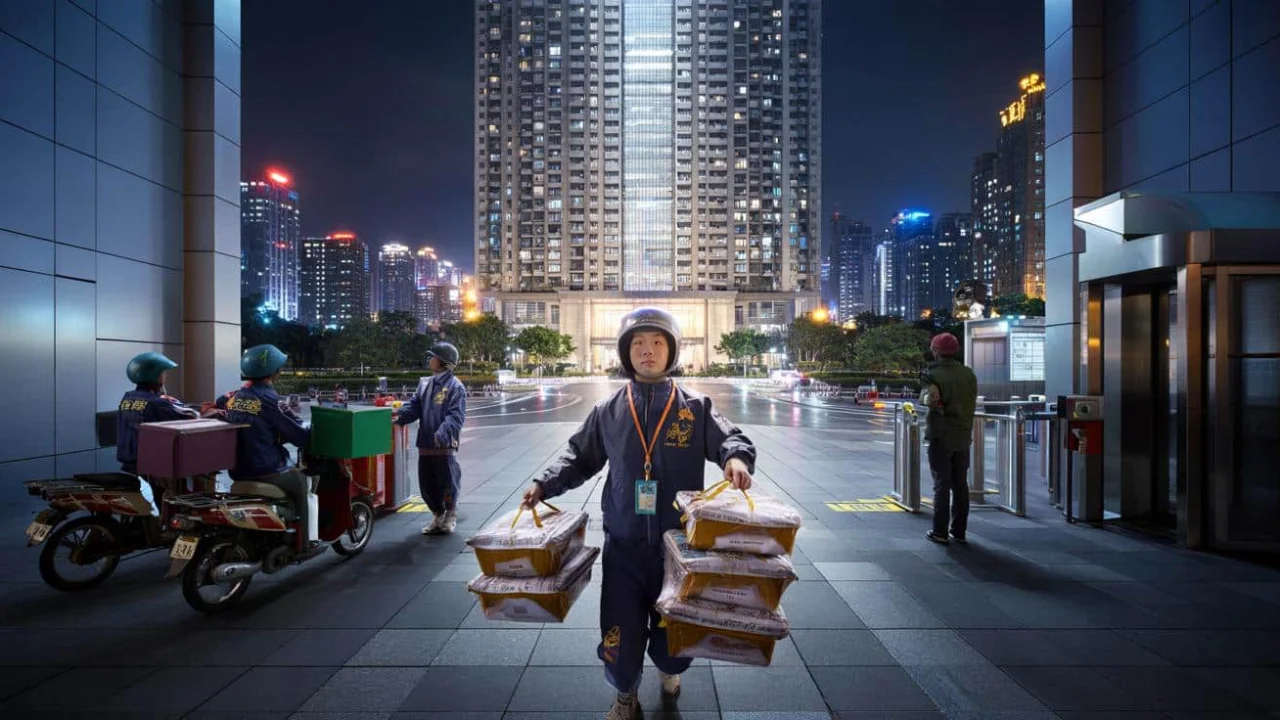
Li Wei checks his phone as he stands in the marble lobby of Tower C, a 68-story residential complex in Shenzhen. Three food delivery bags sit at his feet, each tagged with apartment numbers somewhere high above. Outside, motorcycle couriers zoom past in the evening rush, but Li’s workday happens entirely indoors. His job didn’t exist five years ago, yet now he makes decent money doing something that sounds almost absurd: delivering food to other delivery workers.
Every evening around 6 PM, Li becomes part of an intricate dance that plays out in hundreds of China’s tallest buildings. Regular food couriers drop off multiple orders at the entrance, then speed away to their next pickup. Li takes over, navigating security checkpoints, crowded elevators, and endless hallways to get your dinner to your door.
This is skyscraper food delivery in modern China, where buildings have grown so tall that getting food to the top requires a relay race between different workers.
When Buildings Outgrow Their Systems
China’s urban skyline transformed faster than anyone predicted. Shenzhen went from fishing villages to a forest of glass towers in just three decades. Today, residential buildings routinely stretch 40, 50, even 70 floors into the sky, housing thousands of families in vertical neighborhoods.
Food delivery apps exploded alongside this vertical growth. In Chinese cities, ordering meals through smartphones became as routine as checking email. But nobody anticipated how these two trends would collide in building lobbies across the country.
“Regular delivery riders lose 15 to 20 minutes per trip when they have to go upstairs,” explains Zhang Ming, who manages logistics for a major food delivery platform. “That’s time they can’t spend earning money on the road.”
The math is brutal for motorcycle couriers. Delivery platforms pay per completed order, not per hour. Every minute spent hunting for apartment 4523 in a maze-like building directly cuts into their daily earnings. When you’re trying to complete 30 deliveries in a shift, those lost minutes add up fast.
Traditional couriers face several time-consuming challenges in China’s mega-towers:
- Security checkpoints that require registration and ID scanning
- Elevator wait times during peak hours, sometimes 10+ minutes
- Confusing floor layouts with hundreds of nearly identical doors
- Parking restrictions that force them to leave scooters far from entrances
- Building access codes that change regularly for security
The Economics Behind Relay Delivery
Enter the relay delivery worker, a job that exists purely because China’s buildings grew too tall too fast. These workers solve a simple efficiency problem: they know their building inside and out, while street couriers know the roads.
The economic model works for everyone involved. Here’s how the money flows in this unique system:
| Worker Type | Payment per Delivery | Deliveries per Hour | Hourly Earnings |
|---|---|---|---|
| Street Courier (with building time) | 4-6 yuan | 3-4 orders | 12-24 yuan |
| Street Courier (lobby drop-off) | 4-6 yuan | 8-10 orders | 32-60 yuan |
| Relay Worker | 2-3 yuan | 6-8 orders | 12-24 yuan |
Relay workers typically earn 2-3 yuan per trip upstairs, which might sound small until you consider the volume. During dinner rush, a busy building might see 50-100 food deliveries per hour. One relay worker can handle multiple orders per elevator trip, making decent money without ever leaving their neighborhood.
“I live on the 12th floor, so I know every shortcut and which elevators are fastest,” says Chen Lu, who works as a relay courier in her own building. “The regular delivery guys appreciate not having to figure out our confusing layout.”
A Job Born from Urban Reality
This micro-profession reveals something fascinating about how cities adapt to rapid change. When infrastructure can’t keep up with growth, people create workarounds that eventually become entire job categories.
The typical relay delivery worker isn’t someone who planned this career. Many are:
- Residents of the same building looking for flexible income
- Retirees who want part-time work close to home
- Students living in nearby university housing
- People with mobility issues who can’t ride motorcycles
- Workers between jobs who need temporary income
The work appeals to people who want the gig economy’s flexibility without the physical demands of motorcycle delivery. There’s no need for special licenses, vehicle maintenance, or navigating traffic. The biggest requirement is simply knowing your building well.
“My grandmother does this job three evenings a week,” explains Liu Yan, a Shenzhen office worker. “She makes extra spending money and gets her daily exercise walking the building. It’s perfect for her.”
Building management companies have largely embraced the system. Relay workers reduce lobby congestion during meal times and help maintain security by limiting unfamiliar people in elevators. Some buildings even provide official vest or ID cards for their regular relay workers.
What This Means for the Future
The emergence of skyscraper food delivery relay workers highlights broader questions about urban living in the 21st century. As more cities build upward instead of outward, similar adaptations will likely appear worldwide.
Food delivery companies are already experimenting with building-specific logistics. Some major platforms now maintain lists of reliable relay workers for their busiest high-rise destinations. A few companies have tested automated systems, including robots and pneumatic tubes, but human relay workers remain cheaper and more flexible.
“This job exists because our cities changed faster than we expected,” notes Dr. Wang Li, an urban planning researcher at Tsinghua University. “It shows how people create solutions when formal systems can’t keep up.”
The relay delivery phenomenon is spreading beyond Shenzhen to other major Chinese cities with dense high-rise living. Similar patterns are emerging in office districts, university campuses, and mixed-use developments where tall buildings create delivery bottlenecks.
For consumers, the system mostly works invisibly. You order food, it arrives at your door, and you probably never think about the two different people who handled your meal along the way. But for thousands of workers, this accidental profession provides flexible income in an economy where traditional jobs are increasingly uncertain.
FAQs
How much do relay delivery workers typically earn?
Most relay workers earn 2-3 yuan per delivery trip upstairs, with busy evening hours bringing 12-24 yuan per hour.
Do buildings officially recognize relay delivery workers?
Many buildings now provide ID cards or vests for regular relay workers to help with security and access.
Is this job spreading to other countries?
Similar systems are starting to appear in other dense Asian cities with many high-rise residential buildings.
What qualifications do you need to become a relay delivery worker?
The main requirement is knowing your building well – most workers live in the same complex or nearby.
How do customers pay for this extra service?
Customers don’t pay extra – the delivery platforms absorb the cost because it makes their street couriers more efficient.
Could robots replace relay delivery workers?
Some companies are testing automated systems, but human workers remain more cost-effective and flexible for most buildings.

Related Posts