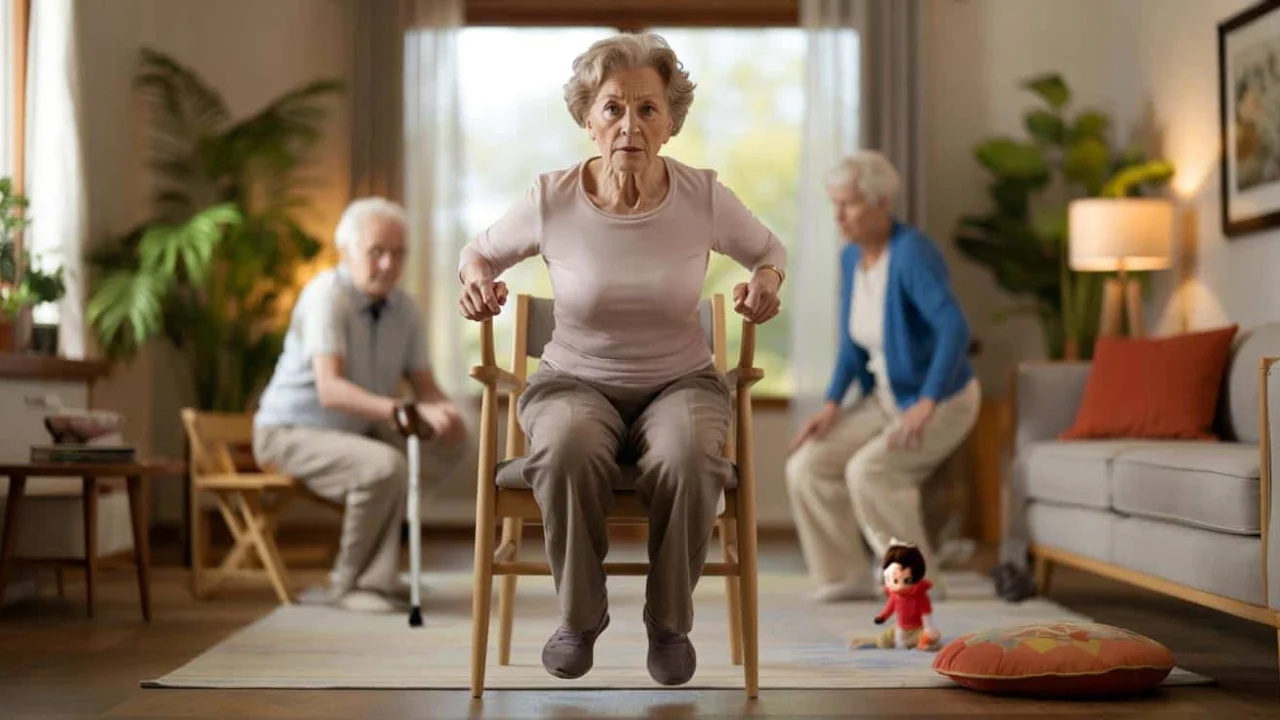
Margaret had been walking three miles every morning for fifteen years. At 73, she felt proud of her routine, telling friends she was “staying active.” But when her grandson’s toy car rolled under the coffee table, she found herself staring at it helplessly. Getting down to the floor felt impossible. Getting back up felt terrifying.
Her doctor later explained something that surprised her: “Your walking is wonderful, but we need to talk about how you move between positions.”
Margaret discovered she wasn’t alone. Millions of active older adults can walk for miles but struggle with the simple act of standing up from a chair without using their hands.
The Movement Pattern That Matters More Than Your Step Count
While most health advice for people over 70 focuses on cardio exercise and strength training, researchers have identified a specific movement pattern that’s a better predictor of independence and longevity. It’s not about how many steps you take or how much weight you can lift.
The movement pattern that matters most? Transition movements – specifically, your ability to move smoothly between sitting, standing, and floor positions without relying on your hands for support.
“We call them transition movements because they represent the transitions that define independent living,” explains Dr. Sarah Chen, a geriatric physical therapist. “If you can’t get out of a chair easily, your world starts shrinking before you even notice it happening.”
A landmark Brazilian study followed over 2,000 adults aged 51 to 80, testing their ability to sit down on the floor and stand back up using minimal hand support. The results were striking: those who scored poorly on this simple test had significantly higher mortality rates over the following decade, even after accounting for age and existing health conditions.
What Makes This Movement Pattern So Crucial
Transition movements combine multiple physical systems in ways that daily walks simply don’t address. Every time you stand up from a chair, your body performs a complex coordination of:
- Leg and glute strength to power the movement
- Core stability to maintain balance during the transition
- Joint mobility in hips, knees, and ankles
- Balance and proprioception to control the movement
- Coordination between all muscle groups working together
“Think of it as your body’s daily systems check,” says physical therapist Mark Rodriguez. “When this movement pattern starts breaking down, it’s often the first sign that multiple systems are declining together.”
The practical impact is enormous. Consider how many times per day you need to:
| Daily Activity | Movement Pattern Required | Impact if Difficult |
|---|---|---|
| Getting out of bed | Sit-to-stand transition | Delayed morning routine, assistance needed |
| Using the bathroom | Stand-to-sit, sit-to-stand | Loss of privacy, increased fall risk |
| Entering/exiting cars | Complex transition movement | Limited mobility, social isolation |
| Picking up dropped items | Standing-to-floor movement | Items left on floor, home safety issues |
| Getting up from low chairs | Sit-to-stand from challenging position | Avoided social situations, restaurant limitations |
Simple Training That Delivers Powerful Results
The encouraging news is that this movement pattern responds quickly to targeted practice. You don’t need expensive equipment or a gym membership – just your existing furniture and a commitment to daily practice.
Start with the basic chair stand test. Sit in a sturdy chair with your feet flat on the floor. Cross your arms over your chest and stand up without using your hands. Can you do it smoothly? Can you do it five times in a row?
“Most of my patients are shocked by how quickly they improve,” notes Dr. Chen. “We’re not asking them to run marathons. We’re asking them to master the movements they need for daily life.”
The progression is straightforward:
- Week 1-2: Practice standing from a standard chair 5-10 times, twice daily
- Week 3-4: Add controlled sitting back down, focusing on smooth movement
- Week 5-6: Practice with a slightly lower chair or cushion
- Week 7-8: Add floor transitions if appropriate for your fitness level
The key is consistency, not intensity. “I tell my patients to think of it like brushing their teeth,” Rodriguez explains. “It’s a daily maintenance activity that prevents major problems down the road.”
Why This Matters More Than Traditional Exercise
Traditional exercise programs for older adults often focus on isolated muscle groups or cardiovascular fitness. While these are valuable, they don’t always translate to the complex, integrated movements required for daily living.
Consider the difference: walking on a treadmill trains your cardiovascular system and leg muscles in a predictable, stable environment. Standing up from a chair requires rapid coordination between multiple muscle groups while maintaining balance through a moving center of gravity.
“We see patients who can walk for hours but need assistance getting off the toilet,” explains Dr. Chen. “The movement patterns are completely different, and you need to train specifically for the movements that matter most for independence.”
Research supports this approach. A 2019 study in the Journal of Aging and Physical Activity found that older adults who practiced transition movements three times per week for eight weeks showed greater improvements in functional independence than those who followed traditional strength training programs.
The participants didn’t just get stronger – they got more confident. They started accepting social invitations again. They felt secure traveling. They stopped avoiding activities that required getting up and down.
Starting Your Movement Pattern Practice Today
Beginning this practice doesn’t require major life changes. Start where you are, with what you have.
If standing from a chair without hands feels impossible, start by using minimal hand support – just fingertips on the armrest. If that’s too challenging, begin with a higher chair or add a cushion to raise the starting position.
“The goal is smooth, controlled movement, not heroic efforts,” Rodriguez emphasizes. “We’re building a sustainable practice that becomes as automatic as walking.”
Pay attention to how the movement feels. Are you throwing your upper body forward to generate momentum? Are you holding your breath? These compensations often indicate areas that need focused attention.
Track your progress simply. Can you do more repetitions this week than last week? Does the movement feel smoother? Are you using less hand support? These small improvements compound over time into significant functional gains.
FAQs
How often should I practice transition movements?
Daily practice is ideal, even if just for 5-10 repetitions. Consistency matters more than intensity for building this movement pattern.
What if I can’t stand from a chair without using my hands?
Start with minimal hand support and gradually reduce assistance over time. Using fingertips on armrests is a good intermediate step.
Is this safe for people with knee or hip problems?
Consult your healthcare provider first, but many people with joint issues can safely practice modified versions. Start slowly and stop if you experience pain.
How quickly will I see improvements?
Most people notice improvements in movement control and confidence within 2-3 weeks of consistent practice. Significant strength gains typically occur over 6-8 weeks.
Should I still do my regular walks and exercise?
Absolutely. This movement pattern training complements your existing activities. Think of it as adding a crucial missing piece to your fitness routine.
Can I practice this if I live in a small space?
Yes. You only need access to a sturdy chair and a few feet of floor space. This makes it perfect for apartment living or limited mobility situations.

Related Posts