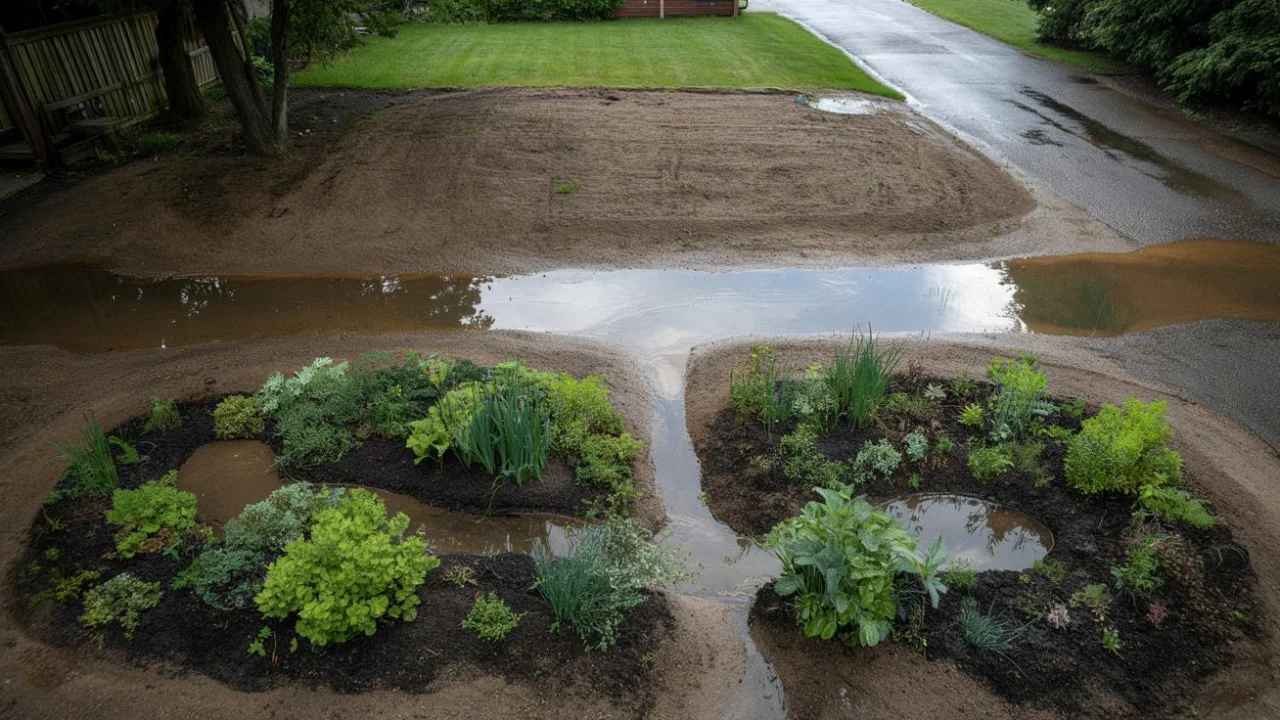
Last summer, my neighbor Sarah called me over to her fence line, frustrated and confused. We’d both planted identical vegetable gardens in spring – same tomatoes, same peppers, same everything. Our soil test results were nearly identical too. Yet her plants were struggling while mine thrived, even though we lived just twenty feet apart.
“I water twice as much as you do,” she said, pointing at her wilted basil. “What am I doing wrong?”
Standing there, I noticed something neither of us had paid attention to before. When I watered my garden, the water pooled gently around each plant. When Sarah watered hers, it ran straight toward her back fence like it was late for an appointment. The difference wasn’t in our soil or our care – it was in the barely perceptible slope of our yards.
Why garden water retention depends more on shape than soil
Most gardeners obsess over soil amendments, compost ratios, and fertilizer schedules. Meanwhile, the simple topography of their space is quietly directing water exactly where it doesn’t need to go. Garden water retention isn’t just about what’s in your soil – it’s about how your landscape holds and moves moisture.
Even a slope as gentle as two inches over ten feet can transform your watering efforts into an expensive exercise in futility. Water follows the path of least resistance, and if that path leads away from your plants, no amount of premium potting mix will help.
“I see this constantly,” explains landscape designer Michael Rodriguez, who’s worked on residential gardens for over fifteen years. “Homeowners spend hundreds on soil improvements, then wonder why their plants are still thirsty. The answer is usually right under their feet – literally.”
The good news? Understanding your garden’s water flow patterns is easier than you think, and fixing them doesn’t require a bulldozer.
Reading your yard’s water story
Your garden tells you exactly where water goes if you know how to listen. After the next decent rainfall, take a walk around your space and look for these telltale signs:
- Dark, consistently moist patches that stay wet longer than surrounding areas
- Dry spots that seem to shed water like a duck’s back
- Visible water channels or erosion patterns, even tiny ones
- Plants that thrive in certain zones while identical specimens struggle nearby
- Areas where mulch gets washed away repeatedly
These clues reveal your yard’s hidden topography. What looks flat to your eye might actually be a series of subtle ridges and valleys that control where every drop of water ends up.
| Water Retention Zone | Characteristics | Best Plants |
|---|---|---|
| High/Dry Areas | Water runs off quickly, soil dries fast | Drought-tolerant herbs, succulents |
| Collection Areas | Water pools, stays moist longer | Vegetables, moisture-loving perennials |
| Transition Zones | Moderate drainage, balanced moisture | Most annual flowers, standard shrubs |
“The key is working with your natural water flow instead of fighting it,” notes garden consultant Jennifer Chen. “I’ve seen people completely transform their success rate just by moving their tomatoes six feet to a natural low spot.”
Simple fixes that capture more water where you need it
You don’t need heavy machinery to improve garden water retention. Small changes in elevation and strategic barriers can redirect substantial amounts of moisture to your plants.
Creating gentle berms or raised borders along the downhill edge of planting beds acts like a dam, giving water time to soak in rather than escape. Even a three-inch barrier of soil can double the time water spends in your garden.
Depressed planting areas work like shallow basins, naturally collecting water that would otherwise run off. The technique is especially effective for vegetable gardens and annual flower beds that need consistent moisture.
Strategic placement of hardscaping elements – stepping stones, small retaining walls, even decoratively arranged rocks – can interrupt water flow and create micro-collection zones throughout your space.
“I always tell clients to think like water,” says Rodriguez. “Follow the path it wants to take, then give it reasons to slow down and stick around.”
Terracing steep slopes into level planting areas eliminates runoff entirely while creating more usable growing space. Even simple terraces made from landscape timbers or stone can transform a water-shedding hillside into a series of moisture-retaining garden rooms.
When your yard works against you
Some garden layouts actively fight water retention. Raised beds positioned on slopes become elevated islands that shed water faster than ground-level plantings. Paths and patios that channel runoff directly toward property boundaries rob nearby plants of natural irrigation.
Dense clay soil gets blamed for poor drainage, but often the real culprit is surface water that never gets a chance to penetrate slowly. Fast runoff overwhelms soil’s ability to absorb moisture, leaving plants thirsty on ground that should be naturally water-retentive.
Compacted areas from foot traffic or equipment create invisible water barriers that direct moisture away from root zones. These hard-pan patches might be scattered throughout your garden, creating a puzzle of wet and dry zones that seems impossible to solve.
“The most common mistake I see is assuming all parts of a yard behave the same way,” explains Chen. “Every garden has its own unique water personality. Success comes from learning that personality and working with it.”
Understanding your garden’s water retention patterns transforms how you approach everything from plant selection to watering schedules. Instead of fighting against natural water flow, you can harness it to create a more resilient, self-sufficient growing space.
The next time you water your garden, watch where that water actually goes. Your plants – and your water bill – will thank you for paying attention.
FAQs
How can I tell if my garden has poor water retention?
Watch what happens when you water or after it rains – if water runs off quickly or plants are thirsty again within hours, your garden likely has retention issues.
Do I need professional help to fix water retention problems?
Most water retention issues can be solved with simple DIY solutions like creating berms, adjusting bed height, or redirecting runoff patterns.
Will fixing water retention reduce my watering needs?
Yes, improving how your garden captures and holds water can cut watering requirements by 30-50% in many cases.
Can I improve water retention without changing my garden’s appearance?
Absolutely – subtle grade changes, strategic plant placement, and hidden drainage features can dramatically improve retention while maintaining your garden’s look.
What’s the easiest first step to improve garden water retention?
Start by creating a small berm or raised edge along the downhill side of your planting beds to slow water runoff.
How much slope is too much for good water retention?
Slopes greater than 10-15% (roughly 1-2 inches per foot) typically need terracing or other interventions to retain water effectively.

Related Posts